B2B SaaS · Business Operating System
A B2B business operating-system concept bringing invoicing, procurement, pipeline, cash flow, and AI-powered business intelligence into one unified experience.
Visit live site- Category
- B2B SaaS · Business Operating System
- Role
- Product design, UI/UX, frontend development
- Year
- 2026
- Stack
- Next.js · TypeScript · Tailwind CSS · Framer Motion · Three.js
01Section
Overview
QEVANTA is a concept for a B2B operating system: one product where invoicing, procurement, sales pipeline, and cash flow live together, with an AI layer that reasons over the same data instead of a bolted-on chatbot.
The goal of the concept was to show how a serious, enterprise-grade product can be positioned with clarity and confidence rather than feature lists.
02Section
The Challenge
B2B software is usually explained through screenshots of tables. That communicates complexity, not intelligence. The concept needed a first impression that made the product feel unified and deliberate while still speaking to operators who care about real workflows.
03Section
Product Strategy
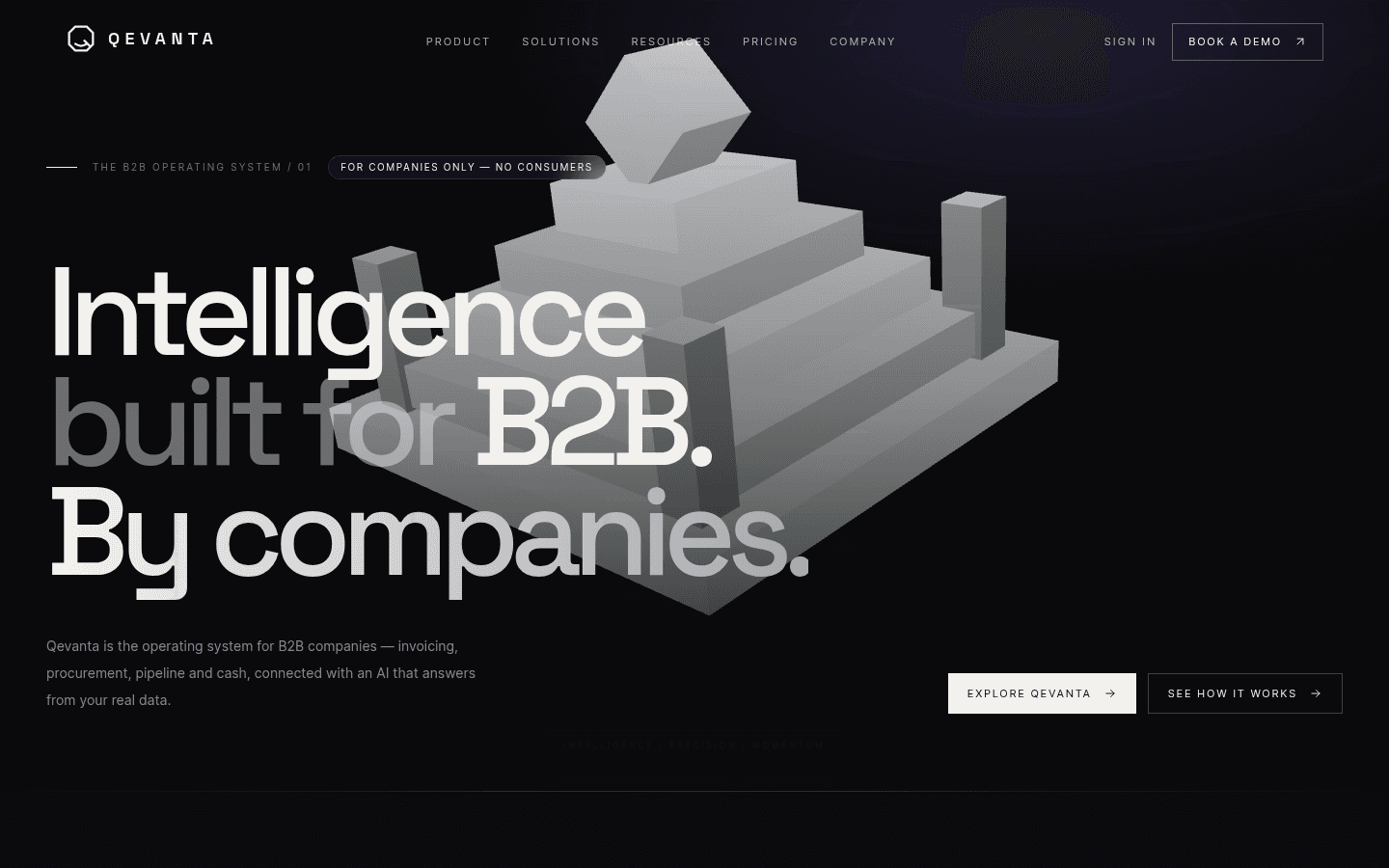
The positioning line “Intelligence built for B2B. By companies.” anchors the product as company-first and explicitly not consumer software. Every module is framed as a connected part of one system rather than a stand-alone feature.
- Invoicing
- Procurement
- Pipeline
- Cash flow
- AI business intelligence
04Section
UX / UI
A monochrome palette, wide letter-spaced navigation, and an oversized display headline give the page an editorial rhythm. Secondary information is kept small and technical so hierarchy stays unambiguous.
05Section
Development
Built with Next.js, TypeScript, and Tailwind CSS. The 3D stepped structure in the hero is rendered with Three.js and kept lightweight so it enhances the composition without hurting load performance.
06Section
AI / Automation
The concept frames AI as a query layer over the company’s real data: answers about cash, receivables, and pipeline come from the same source of truth as the operational modules.
07Section
Technical Architecture
A component-driven Next.js frontend with a centralized content model, motion handled through Framer Motion, and a WebGL scene isolated in its own client component so the rest of the page stays server-rendered.
08Section
Final Experience
A calm, confident landing experience that reads as a product rather than a template: one strong focal object, one message, and a structure that makes the scope of the system obvious within seconds.
09Section
Live Project
The best way to evaluate the work is to use it. Open the live project in a new tab.